
The 30 Weirdest Laws in Texas That Are Still on the Books
Texas has a long legislative history, and over the decades lawmakers have passed statutes that seem unusual by today’s standards. Some of these laws come from older social norms, others were practical fixes for specific problems, and many simply never got repealed as the years passed. You can still find them in the Texas Penal Code, the Transportation Code, and other parts of state law, even if some are rarely enforced.
Many lists of “weird Texas laws” circulating online are inaccurate or based on urban legends with no basis in actual statutes. This list only includes laws that are real and can be looked up in the Texas statutes, the Texas Constitution, or the federal record. Here are 30 of the strangest ones still on the books.
1. Car Dealers Can’t Sell Cars on Both Saturday and Sunday (Transportation Code § 728.002)
If you shop for a car in Texas, you’ve probably noticed most dealerships close on Sunday. That’s not just a scheduling choice. Transportation Code § 728.002 makes it illegal to sell or offer to sell a motor vehicle on both Saturday and Sunday of the same weekend.
The statute also bars dealers from forcing an employee to sell on both days. Each day a vehicle is offered for sale, and each sale, counts as a separate violation.
The rule is a leftover from Texas’s blue laws, which once limited what could be sold on Sundays. Most of those laws have since been repealed, but this one remains in force.
Dealerships simply pick one weekend day to stay closed, and most choose Sunday. The law doesn’t affect private individuals who occasionally sell a personal vehicle, and a dealer can still quote you a price. To many buyers it feels outdated, but it hasn’t been struck down or removed from the code.
2. Liquor Stores Must Close on Sundays and Three Holidays (Alcoholic Beverage Code § 105.01)
If you’ve ever tried to grab a bottle of whiskey on Christmas Day in Texas, you already know this rule. Under Alcoholic Beverage Code § 105.01, liquor can’t be sold on Sundays, New Year’s Day, Thanksgiving Day, or Christmas Day. On every other day, sales are limited to the hours between 10 a.m. and 9 p.m.
There’s an added twist: if Christmas or New Year’s Day lands on a Sunday, the closure extends to the following Monday too. Lawmakers updated this section in 2021 through House Bill 1518, but the Sunday and holiday closures themselves stayed intact.
You might find this odd since you can buy beer and wine at grocery stores on Sundays under separate rules. Liquor just gets treated differently. The law traces back to older blue-law traditions, and it remains fully in force today, even though many states have dropped similar restrictions.
3. Texas Hold’em Is Illegal to Play for Money in Texas (Penal Code § 47.02)

You might assume that a game bearing the state’s name would be legal to play there. Under Texas Penal Code Section 47.02, playing and betting money on cards, dice, or balls counts as gambling, which is a criminal offense.
The statute does offer a narrow defense. If the game happens in a private place, no one profits beyond their own winnings, and every player faces the same odds, the defense can apply.
This means a casual home game with friends might fall under that protection, but a house-banked or commercial game does not fit it. Running a poker game where the house takes a cut goes beyond what the defense covers.
The irony is hard to miss. A card game linked to Texas around the world is treated as illegal gambling in Texas unless it fits that narrow defense, and the underlying law has never been repealed.
4. Teens Can Legally Drink With a Parent Present (Alcoholic Beverage Code §§ 106.04 and 106.05)

Texas sets the drinking age at 21, but there is a narrow exception. Under Section 106.04(b) of the Alcoholic Beverage Code, a minor who drinks alcohol has an affirmative defense if it happens in the visible presence of their adult parent, guardian, or spouse. Section 106.05(b) applies the same idea to possession.
This means a minor is not automatically breaking the law if they drink while their parent is right there. It is not blanket permission, though. The adult must be the minor’s own parent, guardian, or spouse, not a friend’s parent or another adult.
The rule works only as a defense, not as a right to drink anywhere. Bars, restaurants, and stores still cannot sell alcohol to anyone under 21. It feels strange because it allows private, supervised drinking while keeping every commercial sale restriction firmly in place.
5. Coasting Downhill in Neutral Is Against the Law (Transportation Code § 545.406)
If you shift into neutral while driving down a hill, you are technically breaking Texas law. Transportation Code § 545.406 says a driver moving on a downgrade may not coast with the gears or transmission in neutral. In its current form, the rule dates to 1995, when the Legislature reorganized the state’s traffic laws into the Transportation Code.
For truck, tractor, and bus drivers, the rule goes further. They also can’t coast downhill with the clutch disengaged.
The reasoning makes sense from a safety standpoint. In neutral, a vehicle loses engine braking, which makes it harder to control speed on a slope.
Even so, you are unlikely to see this law enforced on its own in everyday driving, which is part of why it strikes modern drivers as an odd rule.
6. Only Three People Can Ride in the Front Seat (Transportation Code § 545.417)
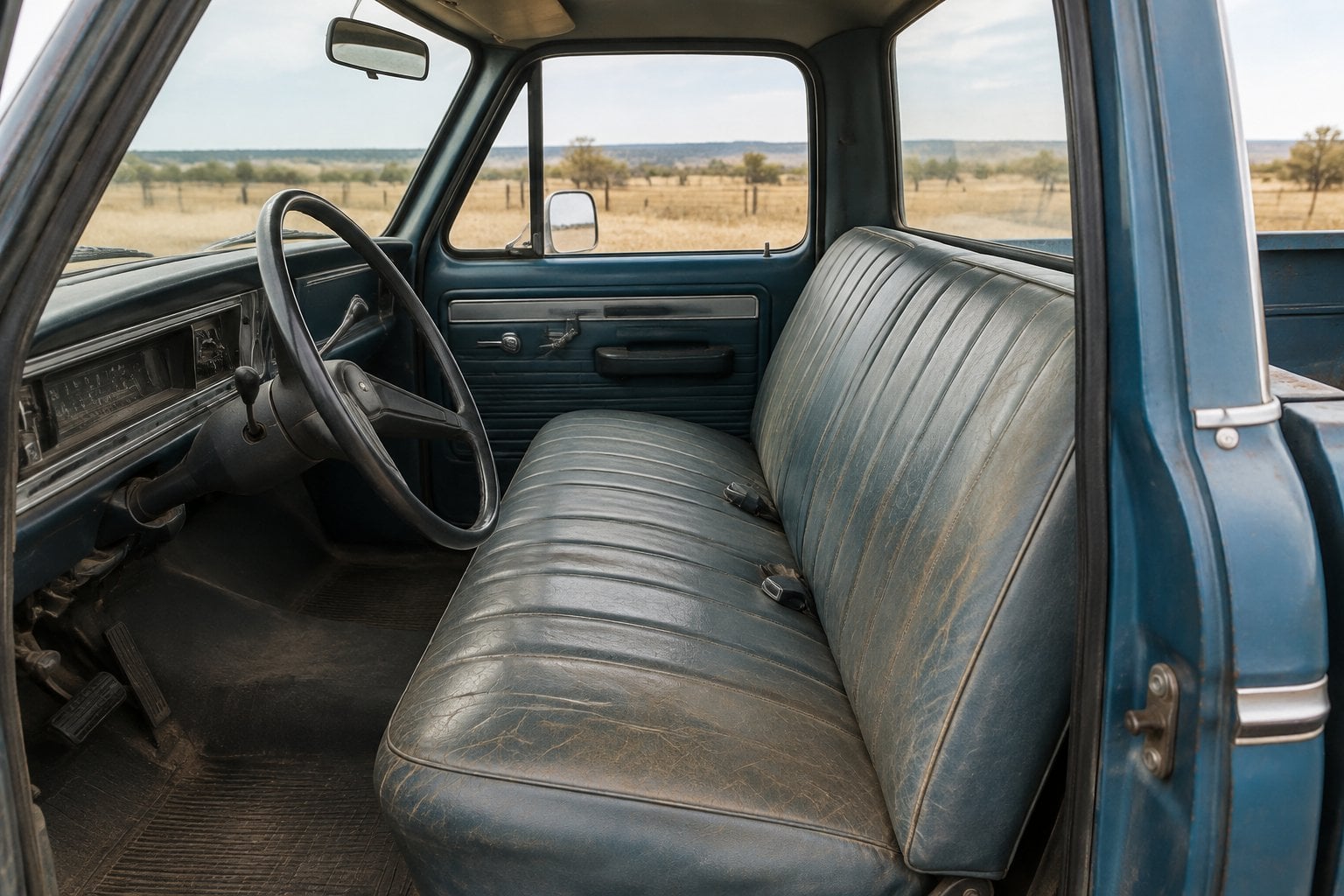
Older cars with bench seats once let four people squeeze in up front. Texas Transportation Code Section 545.417 puts a limit on that. A driver may not operate a vehicle when the front seat holds more than three people if that crowding blocks the driver’s view to the front or sides, or interferes with the driver’s control of the vehicle. The same rule applies to a vehicle so loaded with cargo that the driver can’t see properly.
The law also says a passenger may not ride in a position that blocks the driver’s view or gets in the way of the controls. The section was adopted in its current form in 1995.
With bucket seats and center consoles in most modern vehicles, few drivers could break this law today even if they tried, which is part of what makes it feel like a leftover from another era.
7. It’s Illegal to Ride in a Trailer Pulled by a Truck, Unless It’s a Permitted Hayride (Transportation Code § 545.4191)
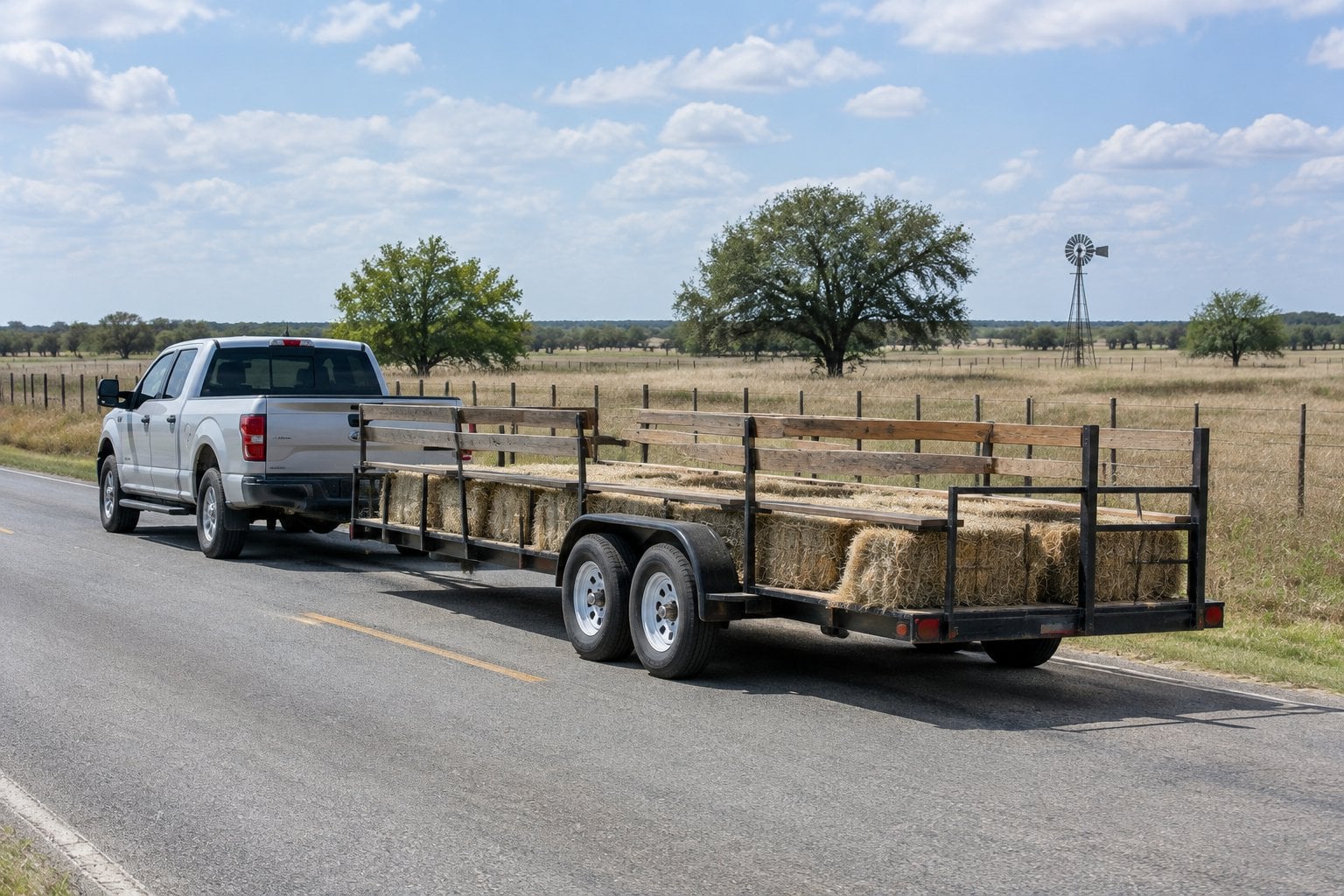
Under Texas Transportation Code § 545.4191, you can’t drive a truck, road tractor, or truck tractor while someone is riding in the trailer or semitrailer it’s pulling. The law took effect in 2003, and a violation is a Class B misdemeanor.
There are exceptions. People may ride in a trailer during a parade or an emergency, or while farmworkers are being moved between fields on farm-to-market, ranch-to-market, or county roads outside a city.
A hayride is also allowed, as long as the county or city has permitted it. It’s also a defense if the driver didn’t know someone was in the trailer, or if the person was in a part built for living in, such as the living area of a travel trailer.
The law seems odd because hayrides get a special carve-out while everyday trailer rides don’t.
8. Hitchhiking From the Roadway Is Banned (Transportation Code § 552.007)

Under Texas Transportation Code Section 552.007, you cannot stand in a roadway to ask drivers for a ride, money, a job, or business. The law targets standing in the road itself, not hitchhiking as such.
Charities are the one exception: they can collect in the road only if the local authority in charge of that roadway gives permission first.
The same section also bans standing on or near a highway to offer to watch or guard someone’s parked car. Both provisions come from a time when roadside solicitation was common enough to need its own statute.
Today, the law reads as a narrow technicality. This section doesn’t cover asking for a ride from the shoulder or sidewalk, though local rules can still apply, which makes it feel more like a traffic-safety measure than a true ban on hitchhiking.
9. You Can Hunt Feral Hogs From a Helicopter (the 2011 “Pork Chopper” Law)

Texas law generally bans hunting from aircraft under Parks and Wildlife Code Section 62.003. But in 2011, state lawmakers passed House Bill 716, widely known as the “pork chopper” law, to create an exception for feral hogs.
Under this law, hunters can pay for a seat on a helicopter and shoot feral hogs from the air, as long as the operation holds a Texas Parks and Wildlife Department aerial wildlife management permit and the landowner has authorized it.
The reasoning is practical. Feral hogs damage crops, land, and property across the state, and hunting from the ground alone hasn’t kept their numbers in check.
Still, paying to shoot animals from a helicopter strikes many people as an unusual way to manage wildlife. It remains legal today and has become a niche business for hunters looking for something different.
10. Hunting From a Car or Boat Is Mostly Banned (Parks and Wildlife Code § 62.003)
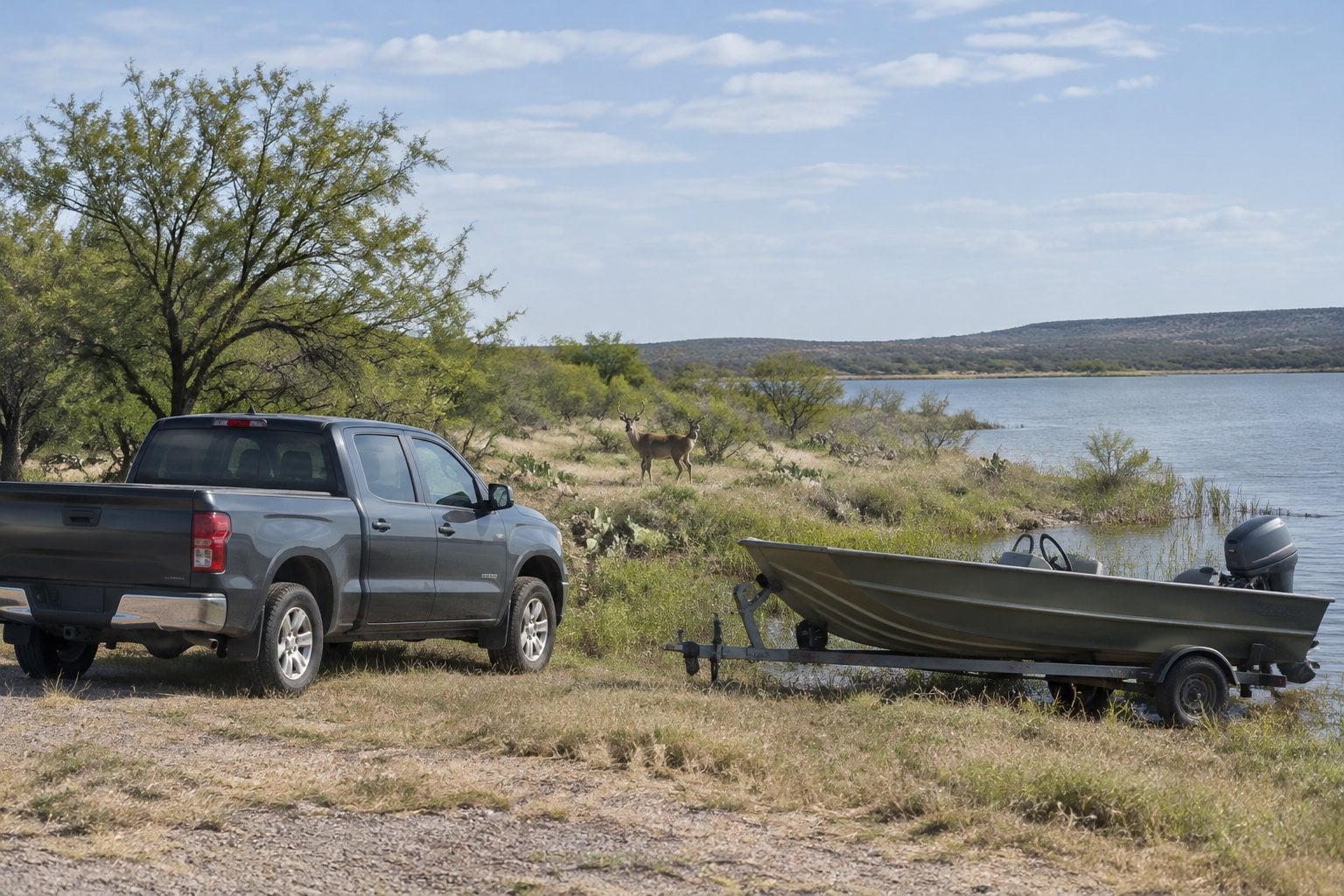
You might assume shooting from a vehicle is always off limits in Texas, but the rule is more nuanced than that.
Parks and Wildlife Code Section 62.003 says you cannot hunt wild birds or wild animals from an aircraft, motor vehicle, powerboat, sailboat, or other floating device. Alligators, frogs, and turtles are the exceptions.
There is another exception. Someone legally on private property or private water to hunt can hunt non-migratory animals and birds from a vehicle or boat there.
The law draws a firm line at public roads, though. No one may attempt to hunt from any part of the state road system. What seems odd is how many carve-outs exist in a law that sounds, at first glance, like a flat ban.
The wording is broader than the title suggests. The ban covers “any type of aircraft or airborne device,” not just planes, and it applies to a motor vehicle, a powerboat, a sailboat, or any other floating device. The private-property exception only works for a person who is on the land or water legally for the purpose of hunting. Two older subsections were repealed in 1985, and the section was last amended in 2005.
11. You Can Own a Tiger, but You Need a Certificate and $100,000 in Insurance (Health and Safety Code Chapter 822)
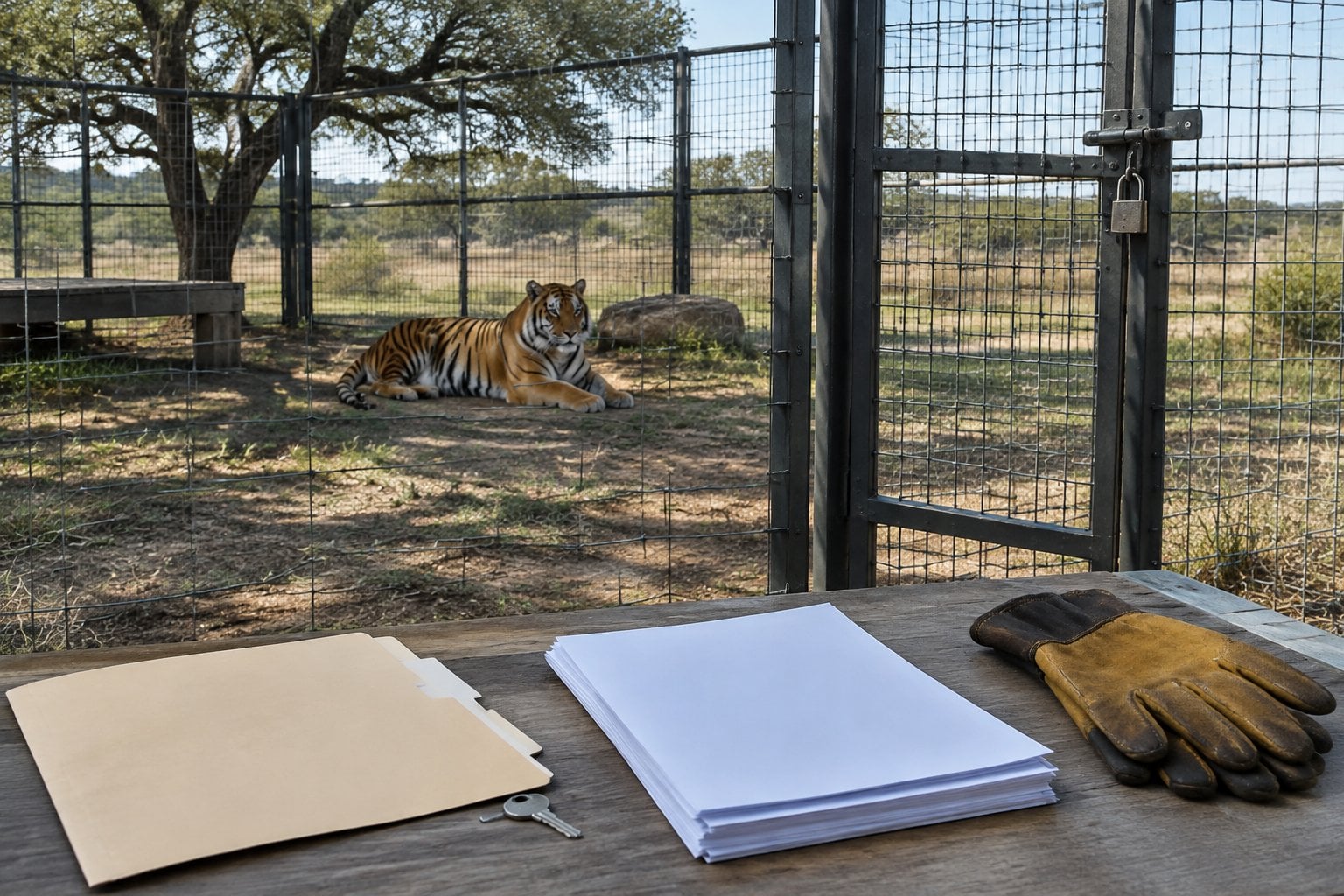
Texas allows you to own a tiger, but not without conditions. Under Health and Safety Code Chapter 822, Subchapter E, added in 2001, you must get a certificate of registration from your local animal registration agency before keeping a tiger, lion, bear, chimpanzee, or similar animal classified as a dangerous wild animal.
The certificate is valid for one year, and the fee cannot exceed $50 per animal or $500 per owner. Owners must also carry liability insurance of at least $100,000 per occurrence.
Cities and counties can ban these animals entirely, so whether you can keep one depends on where you live. The law seems unusual because it treats big cat ownership as a paperwork issue rather than banning it outright. A 2022 federal law now limits new private ownership of big cats, but Texas’s registration system remains on the books.
12. Cattle Brands Must Be Re-Registered Every 10 Years (Agriculture Code §§ 144.041 and 144.044)
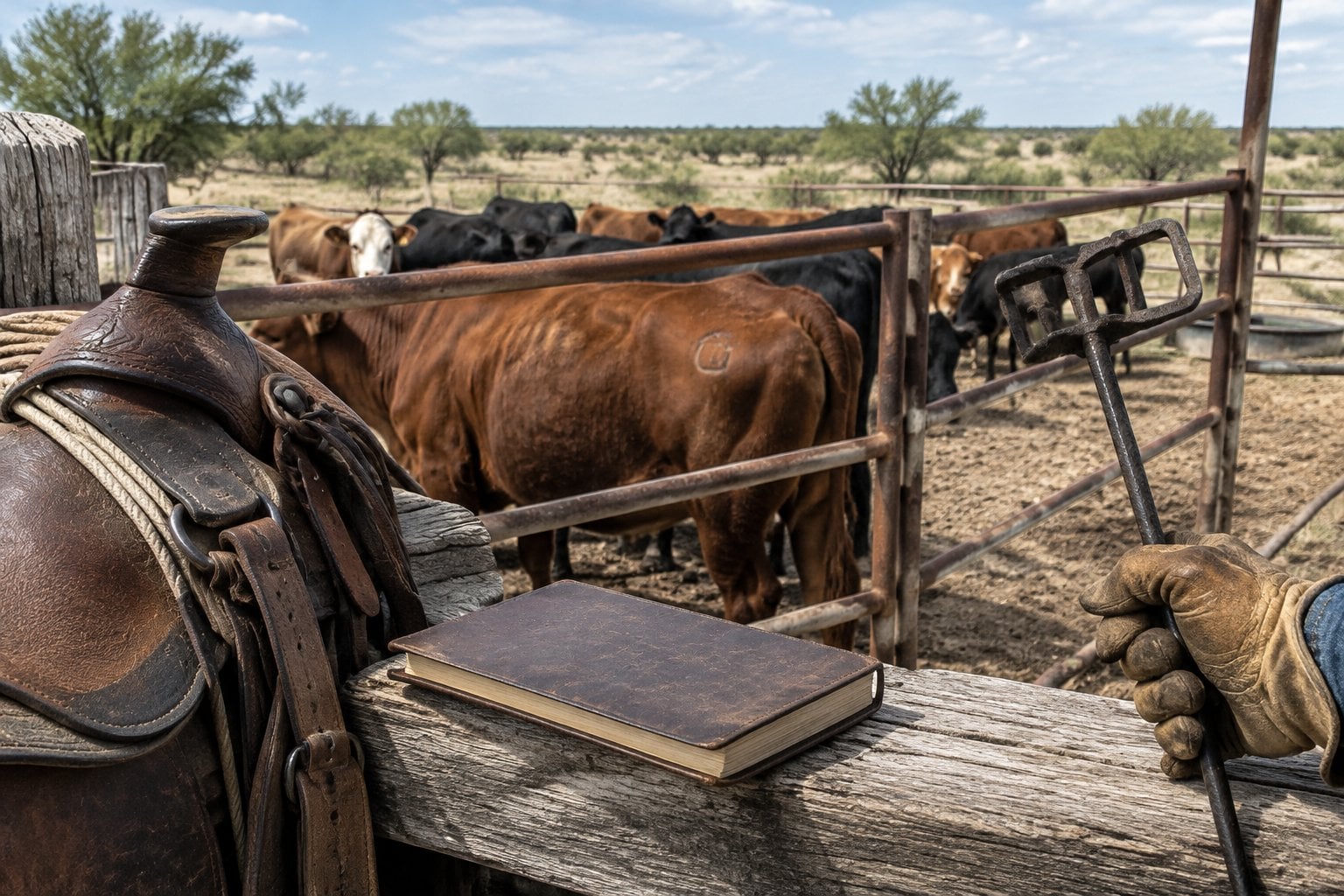
If you own cattle, hogs, sheep, or goats in Texas, state law requires you to record your earmarks and brands with the county clerk in the county where your animals are. This comes from Agriculture Code Section 144.041, a rule rooted in the state’s long ranching history.
Section 144.044 adds a twist. A registration does not last forever. Every ten years, owners must record their brands again, even if nothing about them has changed. Six months after each re-recording period, the older records lose their legal force.
The cycle started from August 30, 1981, with re-recording years in 1991, 2001, 2011, and 2021. The next one is due in 2031. For ranchers, it means paperwork they cannot forget, decades after the original filing.
The recording duty is wider than the headline suggests. Section 144.041 lists earmarks, brands, tattoos, and electronic devices, and a person who owns a horse must record an identification mark with the county clerk too. An owner may record marks in as many counties as needed, and may record any mark nobody else has already recorded. If two people claim the same brand, Section 144.044 gives it to whoever first recorded it in that county, or, if the records don’t show that, to the person who has used it the longest.
13. Fireworks Can Only Be Sold During Certain Weeks (Occupations Code § 2154.202)
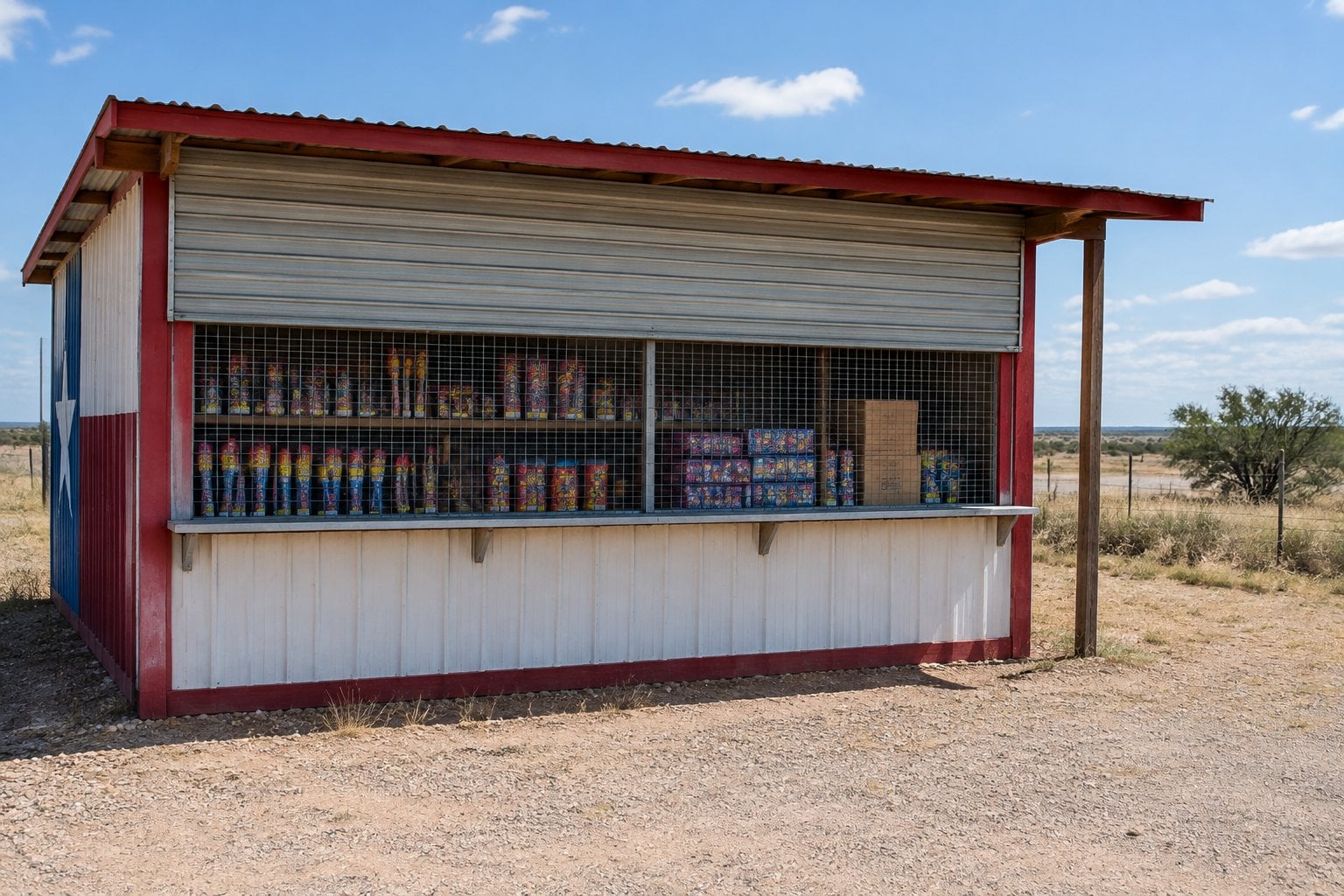
You can’t walk into a fireworks stand in Texas any time of year and make a purchase. Occupations Code § 2154.202 limits retail fireworks sales to specific windows. The main season runs from June 24 through midnight on July 4.
A second window opens December 20 and closes at midnight on January 1. Near the Texas-Mexico border, the county commissioners court can also approve sales from May 1 to May 5 for Cinco de Mayo.
Counties may also allow sales around Texas Independence Day in late February, San Jacinto Day in April, Memorial Day weekend, and Diwali. Outside these periods, retail stands can’t sell fireworks, no matter how badly you want to celebrate a random Tuesday.
Sellers also need paperwork. Anyone selling fireworks directly to the public must get a retail fireworks permit each year for each retail location. The permit fee can’t exceed $20, the permit can be bought on a state website, it can’t be renewed, and it expires every January 31. The border window applies only to locations within 100 miles of the Texas-Mexico border.
14. Cursing in Public Can Be Disorderly Conduct (Penal Code § 42.01)
Texas Penal Code § 42.01 covers disorderly conduct, and one part of it deals with abusive, indecent, profane, or vulgar language in a public place. It only applies when the words, by their very utterance, tend to incite an immediate breach of the peace.
You might assume this means any swearing in a crowded place could get you a ticket. In practice, courts have narrowed this kind of law to “fighting words,” language likely to start a fight on the spot. Ordinary cursing that someone happens to overhear does not meet that bar.
The same statute also covers offensive gestures and creating a noxious odor by chemical means in a public place. A conviction is a Class C misdemeanor, which carries a fine only.
Charges for words alone are uncommon, and they often run into First Amendment challenges.
15. Pointing a Laser at a Security Guard Is a Crime (Penal Code § 42.13)
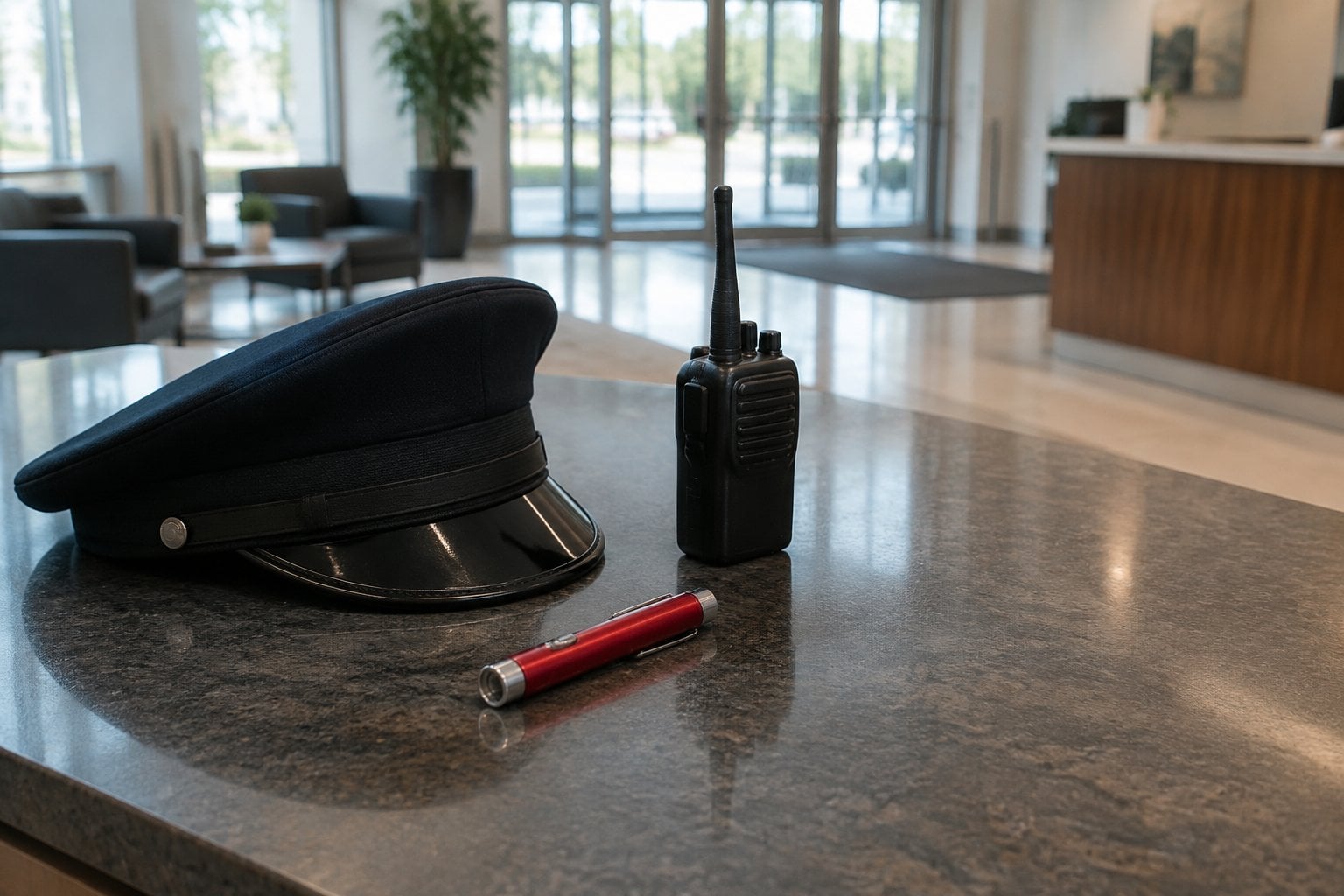
If you point a laser pointer at a uniformed security guard in Texas, you have broken the law. Section 42.13 of the Penal Code makes it illegal to knowingly direct a laser at a uniformed safety officer.
It isn’t limited to security guards. The law also covers peace officers, firefighters, EMS workers, and other uniformed city, state, or federal officers. A basic violation is a Class C misdemeanor.
The penalties jump if someone gets hurt. If the laser causes bodily injury, it’s a third-degree felony. If it causes serious bodily injury, it becomes a first-degree felony.
What makes this statute stand out is how a cheap office gadget can lead to felony charges, depending on what happens.
The law defines a laser pointer as a device that emits visible light amplified by the stimulated emission of radiation. It was added in 2003 and amended in 2021 by House Bill 2366. A Class C misdemeanor carries a fine of up to $500. A third-degree felony means 2 to 10 years in prison and a fine of up to $10,000, and a first-degree felony means 5 to 99 years or life. If the same conduct also violates another law, prosecutors may charge one or the other, but not both.
16. Your Phone Isn’t Allowed Near the Voting Booth (Election Code § 61.014)
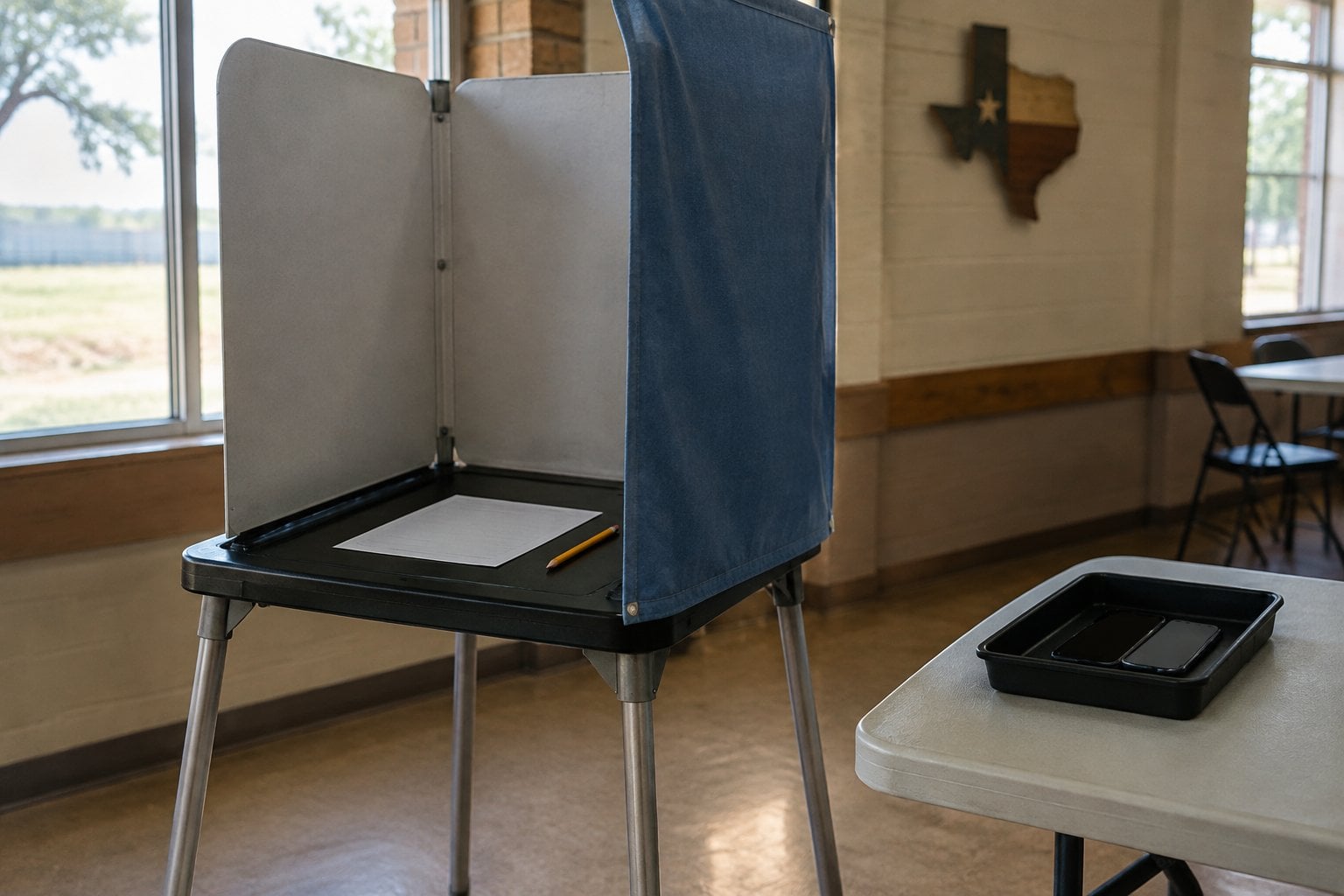
If you’ve ever wanted to snap a selfie with your ballot in Texas, state law says no. Election Code Section 61.014 bars using a wireless communication device within 100 feet of a voting station. It also prohibits recording images or sound within 100 feet of a voting station.
The rule dates to 2007 and has been updated since. The presiding election judge can make a voter turn off the device or leave the polling place.
There are exceptions for election officers, people who work in the building, and the election equipment itself. For everyone else, the phone stays put away while voting. Official voting information is on the state’s VoteTexas.gov site.
The law exists to protect ballot secrecy and prevent intimidation. In an era where people photograph everything, it can feel unusually strict.
17. You Can’t Wear a Campaign T-Shirt to the Polls (Election Code § 61.010)
Many Texans are surprised to learn that their favorite campaign shirt can cause trouble on election day. Texas Election Code Section 61.010 says a person may not wear a badge, insignia, emblem, or similar item relating to a candidate, measure, or political party on the ballot inside a polling place or within 100 feet of any outside door voters use to enter the building.
The rule dates to 1987 and was updated in 1997. A violation is a Class C misdemeanor, the lowest level of offense in Texas, punishable by a fine.
In practice, election workers usually ask voters to cover the shirt, turn it inside out, or take off the button before they vote. The idea is to keep the area around the voting booth free of campaigning so no voter feels pressured. Election officials are the exception: they must wear official name tags while on duty.
18. You Can Get Married Without a Ceremony (Family Code § 2.401)

In Texas, you don’t need a wedding to be legally married. Under Family Code Section 2.401, a couple can have an informal marriage, often called a common-law marriage, without a ceremony or officiant.
To prove this kind of marriage, the couple must show three things: they agreed to be married, they lived together in Texas as spouses, and they told others they were married.
There is also a more direct option. A couple can sign a Declaration of Informal Marriage at the county clerk’s office, which creates an official record.
Texas is one of the few remaining states that still allow new common-law marriages. One detail makes it stranger: if the couple separates and no court case is filed within two years, the law presumes they never agreed to marry at all. No one under 18 can enter an informal marriage.
19. There’s a 72-Hour Wait After You Get a Marriage License (Family Code § 2.204)

Once you get a marriage license in Texas, you can’t use it right away. Family Code § 2.204 says the ceremony may not take place during the 72 hours after the license is issued.
So a courthouse visit followed by vows an hour later usually won’t work. The clock starts when the clerk issues the license.
There are ways around it. Members of the military on active duty are exempt. Completing an approved premarital education course also removes the wait, and a judge can waive it.
The waiting period was meant to prevent rushed marriages. In an era of long engagements, it rarely changes anyone’s plans, which makes it feel like a rule from another time.
The exceptions are spelled out in detail. The military exemption covers active-duty members of the armed forces, and it also covers people who work for the U.S. Department of Defense as employees or under a contract. The premarital course certificate must show the course was finished no more than one year before the license application was filed. A waiver can come from a family-law judge, a county judge, or a justice of the peace, among others, if they find good cause. A license also expires if no ceremony happens within 90 days of issuance.
20. Proxy Weddings Are Allowed Only for Deployed Troops (Family Code § 2.203)

In Texas, one person can get married without showing up to their own wedding, but only in a very specific situation. Family Code Section 2.203 lets a person agree to marry through a proxy, someone who stands in for them at the ceremony, if the person is a member of the U.S. armed forces stationed in another country in support of combat or another military operation and is unable to attend.
The rule was added in 1997 and amended in 2013. The absent service member must sign an affidavit naming the proxy, and the couple still needs a valid Texas marriage license. Everyone else must appear in person.
Only a few states allow proxy marriages at all, so this narrow provision sets Texas apart. It lets deployed troops marry without waiting months to come home.
21. Texas Schoolkids Pledge Allegiance to the Texas Flag Every Day (Education Code § 25.082)

If you went to public school in Texas, you probably recited two pledges every morning. Education Code Section 25.082 requires every school district and open-enrollment charter school to have students say the pledge to the U.S. flag and the pledge to the Texas flag once each school day.
The Texas pledge reads: “Honor the Texas flag; I pledge allegiance to thee, Texas, one state under God, one and indivisible.” The phrase “one state under God” was added by lawmakers in 2007.
The law also calls for a minute of silence afterward. People from other states are often surprised that a state requires a daily pledge to its own flag. A parent can ask in writing for their child to be excused.
The section, added in 1995, says the pledges must be recited once each school day at each campus. It also requires the U.S. and Texas flags to be displayed in each classroom where the pledges are recited, though a school isn’t required to spend public money on them and may accept gifts or donations to buy flags. The text of the Texas pledge itself sits in Government Code § 3100.101, which was amended in 2007.
22. Paddling Is Still Allowed in Texas Public Schools (Education Code § 37.0011)

If you grew up outside Texas, you might assume paddling in schools ended decades ago. Under Texas Education Code § 37.0011, it has not.
The statute defines corporal punishment as deliberately causing physical pain by hitting, paddling, spanking, slapping, or other physical force as discipline. School districts may use it under their own discipline policies.
Parents have a way to opt out. A parent or guardian can give the school a signed statement prohibiting corporal punishment for their child, and the school may not use it on that student.
Many large Texas districts have banned the practice through their own policies, even though state law does not require them to. The result is a patchwork where a student’s experience depends on where they live.
The fine print matters. Corporal punishment is allowed only if the school board has adopted a policy permitting it. The opt-out statement has to be renewed: a parent or guardian must give a separate signed statement each school year, and may revoke it at any time during the year. The definition leaves out physical pain caused by reasonable activity in athletic training, competition, or physical education, and it also excludes restraint authorized under Section 37.0021. The statute was added in 2011 by House Bill 359.
23. No-Gun Signs Need One-Inch Letters in English and Spanish (Penal Code §§ 30.06 and 30.07)
A Texas business that wants to bar licensed handgun carriers can’t just hang a picture of a gun with a line through it. Penal Code Sections 30.06 and 30.07 spell out the exact wording the sign must use, with separate signs for concealed carry and open carry.
The text must appear in both English and Spanish, in contrasting colors, with block letters at least one inch tall, and the sign must be posted where the public can clearly see it.
Miss the wording, the colors, or the letter size, and the sign may not count as legal notice to a license holder. Since permitless carry began in Texas in 2021, separate trespass rules also apply to people carrying without a license. For more on how Texas gun rules work, see our guide to Texas gun laws for felons.
24. You Can Carry a Sword, but Not Into a Bar (Penal Code §§ 46.01 and 46.03)
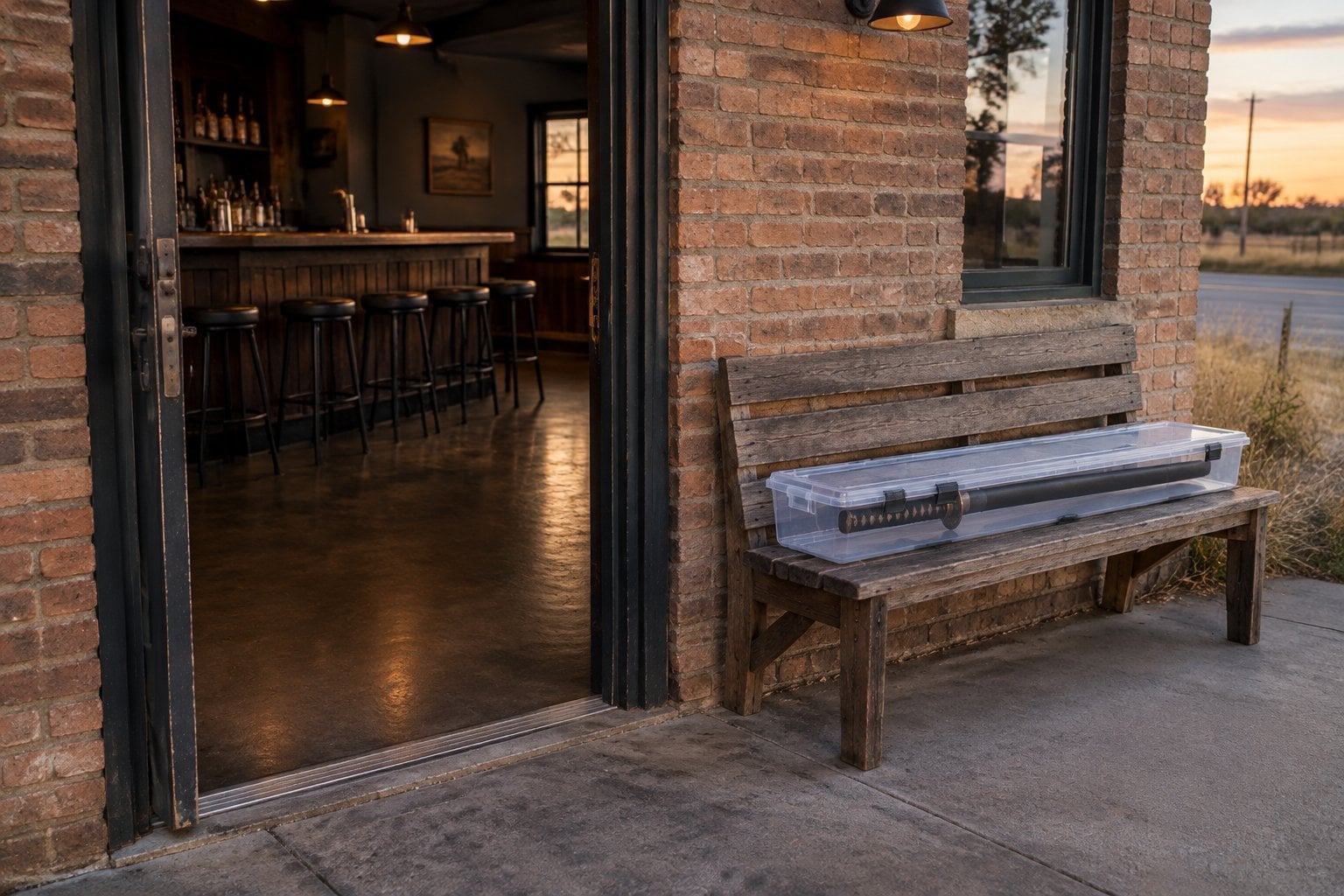
Since September 1, 2017, adults have been allowed to carry a sword in Texas. House Bill 1935 reclassified blades longer than 5.5 inches, including swords, machetes, and Bowie knives, as “location-restricted knives” under Penal Code § 46.01, rather than banning them.
That means an adult can carry one in most public places. People under 18 generally can’t carry one away from home, with a few narrow exceptions, such as under a parent’s supervision.
Penal Code § 46.03 still draws lines on where these knives can go. They’re banned in schools, courts, polling places, racetracks, secured airport areas, and bars or other businesses that make 51% or more of their income from alcohol sold for on-site drinking.
The statute defines a location-restricted knife as one with a blade over five and one-half inches. The restricted-place list in § 46.03 goes on to include correctional facilities, amusement parks, high school, college, and professional sporting events, and the rooms where open government meetings are held. Licensed hospitals and nursing facilities are also on the list unless the person has written authorization from the administration.
25. Spike Strips Are a Prohibited Weapon (Penal Code § 46.05)

Most people think of prohibited weapons as machine guns or explosives, and those are on the list. But Texas Penal Code Section 46.05 also names something you might not expect: a tire deflation device. These are the spiked strips police lay across a road to stop a fleeing car by puncturing its tires.
Under the statute, it is an offense to knowingly possess, make, transport, repair, or sell one, along with zip guns, armor-piercing ammunition, chemical dispensing devices, and improvised explosive devices. The law gives defenses for police agencies, the military, and correctional facilities using them in official duties, and for a few narrow cases such as handling them as antiques or curios.
So while the strips are a common sight in police chases on the evening news, an ordinary driver keeping a set in the trunk could be breaking state law.
26. Your HOA Can’t Ban Rain Barrels or Compost Piles (Property Code § 202.007)

If your homeowners’ association has ever threatened to fine you over a compost bin or a rain barrel, Texas law is on your side. Property Code Section 202.007 stops property owners’ associations from banning certain water-saving and waste-reducing practices.
Under this law, homeowners can compost yard waste, leave grass clippings on the lawn, install rain barrels or rainwater harvesting systems, use drip irrigation, and plant drought-resistant landscaping or water-conserving turf. Any HOA rule that prohibits these is void.
HOAs still keep some control, such as rules on the size, type, shielding, or location of composting devices and rain barrels.
What makes this law feel unusual is that it exists at all. Most people assume yard choices are a private matter, not something the state has to protect from neighborhood associations.
27. You Can’t Start a Backyard Cemetery Near a Big City (Health and Safety Code § 711.008)
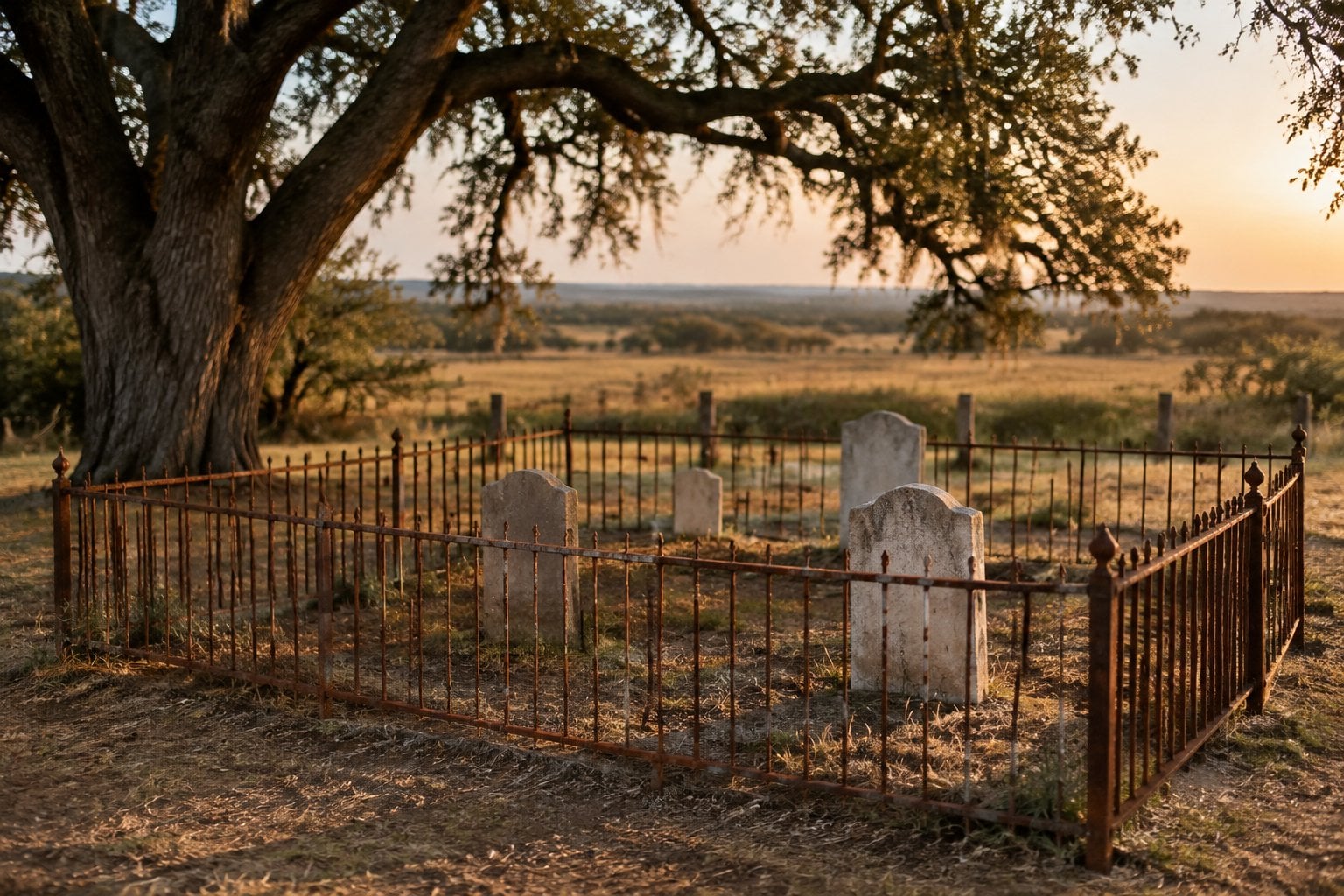
Texas does not ban family burial plots outright, and many old ranch cemeteries still dot the countryside. But Health and Safety Code Section 711.008 sets distance limits that surprise people. No one may set up a cemetery, or use land for burial, within one mile of a city of 5,000 to 25,000 people. The distance grows with the city’s size, up to five miles from the boundaries of any city with at least 200,000 residents.
That means someone living on a few acres outside Houston, Dallas, or San Antonio generally can’t bury a relative on their own land. The law has several exceptions, including cemeteries that already existed and church columbariums for ashes.
Anyone considering a home burial should check with the county and a funeral professional first, since other rules on permits and death certificates also apply.
28. Owning Six or More Adult Toys Was Once Presumed Illegal Intent (Penal Code § 43.23)

Under Texas Penal Code Section 43.23, a person who possesses six or more “obscene devices” is presumed to intend to sell or promote them. That presumption still appears in the statute’s text, in subsection (f).
For years, this meant simply owning several such items could look like evidence of a business, even without any sales.
In 2008, the federal Fifth Circuit Court of Appeals ruled in Reliable Consultants v. Earle that the Texas ban on promoting these devices was unconstitutional. Since that ruling, the device part of the law has not been enforceable.
The text remains on the books, though, which is why it keeps showing up in discussions of odd Texas statutes.
The section is an obscenity law, and its penalties are laid out in the text. Promoting an obscene device, or possessing one with intent to promote it, is a Class A misdemeanor, which carries up to a year in jail and a fine of up to $4,000. Wholesale promotion is a state jail felony. Subsection (g) gives an affirmative defense for a bona fide medical, psychiatric, judicial, legislative, or law enforcement purpose.
29. The Texas Constitution Still Requires Officeholders to Believe in God (Article I, Section 4)

Article I, Section 4 of the Texas Constitution bars any religious test for holding public office. But the same sentence contains a catch: a person can’t be excluded from office for their religious beliefs, “provided he acknowledge the existence of a Supreme Being.”
The wording is part of the 1876 constitution that Texas still uses today, and it reflects assumptions that were common at the time.
In 1961, the U.S. Supreme Court decided Torcaso v. Watkins, striking down a similar requirement in Maryland. That ruling means no state can require officeholders to declare a belief in God, including Texas.
Because of this, the clause can’t be enforced. It stays in the text because removing it would take a constitutional amendment approved by the Legislature and Texas voters.
30. Texas Can Still Split Itself Into Five States (1845 Joint Resolution for Annexing Texas)

You’ve probably heard someone claim Texas can split into five states whenever it wants. The source of that claim is real. It comes from the Joint Resolution for Annexing Texas, approved by Congress on March 1, 1845.
The resolution says that up to four new states, in addition to Texas itself, could later be formed from Texas territory with Texas’s consent. Together with the original state, that makes five.
Texas has never used it.
This is a federal resolution, not a Texas statute, and many legal scholars say Congress would still need to approve any new state under Article IV of the U.S. Constitution. It also has nothing to do with secession. The U.S. Supreme Court settled that question in Texas v. White in 1869, ruling that Texas cannot leave the Union on its own.
Texas has plenty of laws that make sense once you know where they came from, and a few that are simply relics nobody has bothered to repeal. For another look at how Texas regulates everyday life, read our overview of Texas cannabis laws.
This article is for general information only and is not legal advice. Laws change, so check the current statute or talk with a licensed Texas attorney about your own situation.


